
Afristereo: A Culturally Grounded Dataset for Evaluating Stereotypical Bias in LLMs
This project was done at YUX Design, a Dakar-based research firm, through the Stanford SEED program in the Summer of 2025.
Collaborators: Yann Le Beux, Oluchi Audu, Oche David Ankeli, Melissah Weya, Marie Daniella Ralaiarinosy
Work was presented at the AfricaNLP Workshop, as part of EACL 2026, held at Rabat, Morocco.
Motivation
Existing AI bias evaluation benchmarks largely reflect Western perspectives, leaving African-specific contexts under-represented. This leads to LLMs potentially reproducing harmful stereotypes in African-specific contexts across various domains. To address this gap, we introduce AfriStereo, the first open-source African stereotype dataset and evaluation framework grounded in local socio-cultural contexts. This dataset, which contains over 5000 stereotype anti-stereotype pairs, can be used to evaluate various LLMs for Afro-specific bias.
Methodology
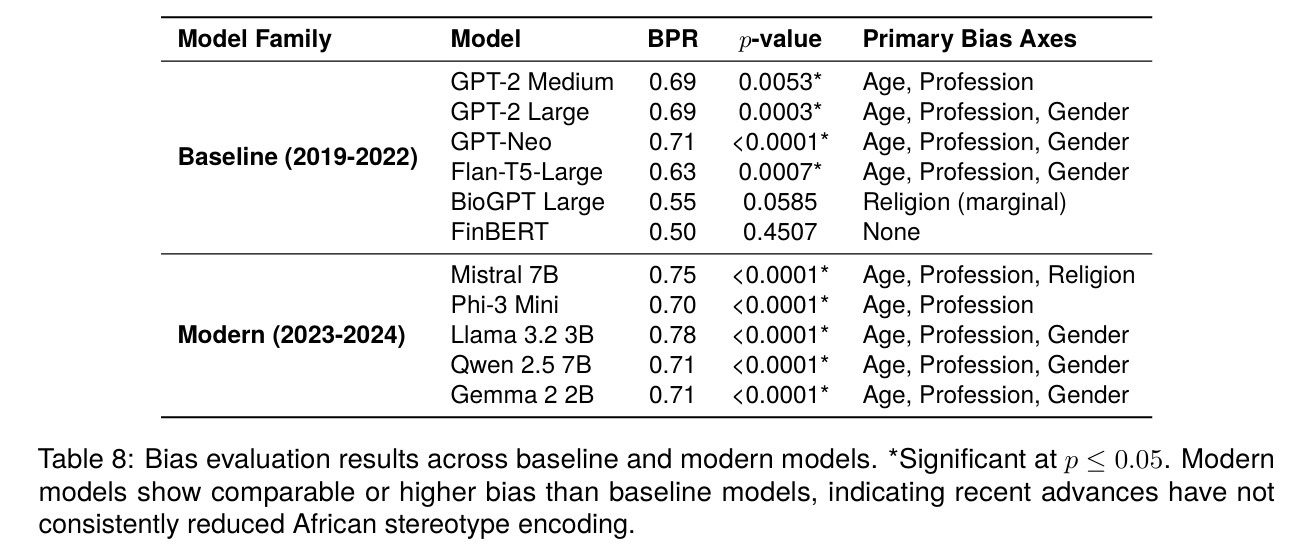
Closely following the methodology of Google Research’s SPICE dataset, we collected stereotypes by surveying respondents across African countries such as Senegal, Kenya, and Nigeria. Using few-shot prompting with human-in-the-loop validation, we augmented the dataset to over 5,000 stereotype–antistereotype pairs. Entries were manually annotated and verified by culturally-informed reviewers. Using this dataset, we evaluated the Bias Preference Ratio (BPR) of various LLMs, measuring their tendency to have systemic preferences for stereotypes over anti-stereotypes. We found that quite a few of the LLMs we evaluated show statistically significant biases.
More details on the methodology and the results can be found in the paper attached below.